CVPR 2026  ·  Instruction-Guided Region Selection

Focus, don't prune.

Identifying instruction-relevant regions for information-rich image understanding.

Mincheol Kwon1, Minseung Lee1, Seonga Choi1, Miso Choi1, Kyeongjin Oh2, Hyunyoung Lee2, Cheonyoung Park2, Yongho Song2, Seunghyun Park3,†, Jinkyu Kim1,4,†

1Korea University   2KT Corporation   3Soongsil University   4Kakao Mobility  ·  †Corresponding authors
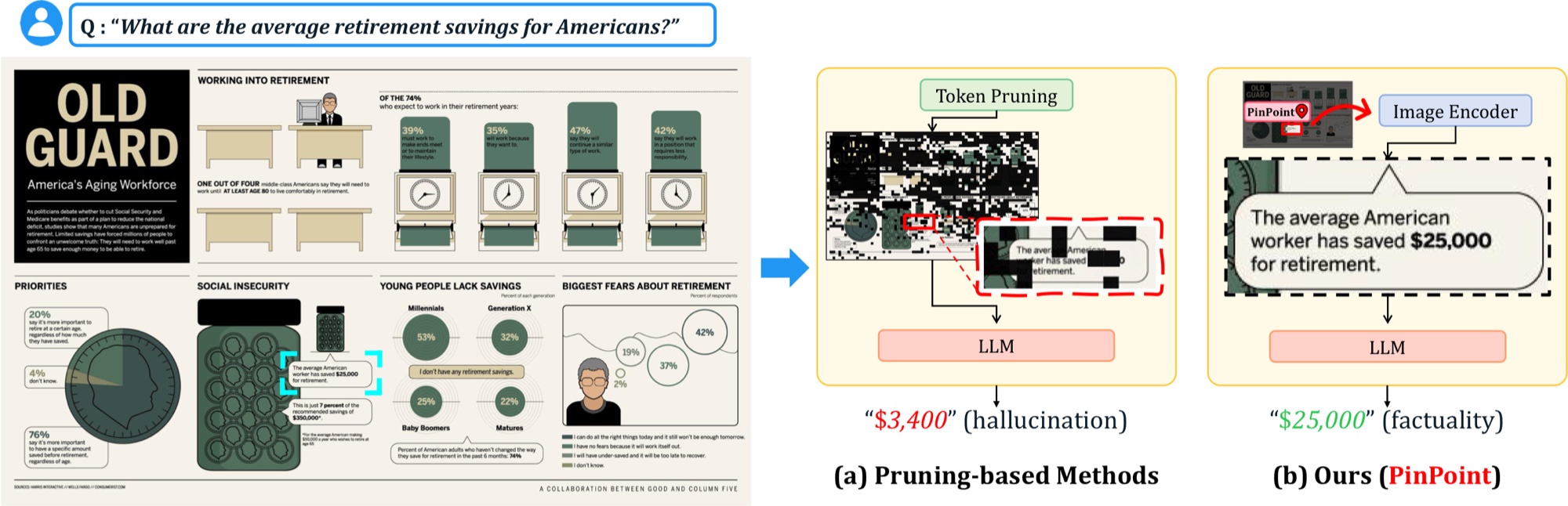
Given the question “What are the average retirement savings for Americans?”, pruning-based methods discard the tokens holding the answer and hallucinate “$3,400”, while PinPoint locates and re-encodes the region and answers “$25,000”.
Figure 1. Pruning-based methods discard the very tokens that hold the answer and hallucinate “$3,400”. PinPoint locates the instruction-relevant region, re-encodes it at full detail, and answers “$25,000”.
In one line

Give the LLM fewer tokens — but the right ones.

Token pruning throws away tokens the attention map thinks are boring, and it is often wrong. PinPoint instead asks where the instruction is pointing, crops those regions, and re-encodes them at full detail. The token budget goes down; the answers get better.

InfoVQA · ANLS
+18.5%

over the vanilla LLaVA-NeXT baseline, using 65.3% of its FLOPs. Against SparseVLM, the strongest prior method, +24.5% ANLS with 4.9% fewer FLOPs.

Trainable parameters
1.4%

Only the guidance queries and two MLPs are trained. The LLM, vision encoder and projector stay frozen — 1.33 GPU-hours to converge on InfoVQA.

New annotations
106k QA

Answer, evidence and encompass boxes for InfoVQA, SPDocVQA and MPDocVQA — with an automated pipeline that keeps manual labelling under 10%.

Two minutes

Watch the overview

Motivation

Irrelevant tokens are not free.

Feed LLaVA-NeXT only the tokens inside the ground-truth region and it answers best. Dilute them with instruction-irrelevant tokens and accuracy falls monotonically. Extra context is not neutral — it is noise you pay for twice, in FLOPs and in accuracy.

Accuracy vs. share of instruction-irrelevant tokens

LLaVA-NeXT-7B · InfographicVQA · Fig. 2

Hover the line to read each point. Left edge: only ground-truth-region tokens. Right edge: every token in the image, undifferentiated.

Failure mode 01 — imperfect attention

The map you prune with is unreliable.

Attention weights in the decoding layers are noisy and can sink onto uninformative positions, so pruning by attention score removes tokens the answer actually needed and the model hallucinates a plausible number instead.

Failure mode 02 — fragmentation & entanglement

A word is not one token, and no token is alone.

Text spans many tokens, so per-token decisions cut phrases in half. And because self-attention is global, tokens inside the answer region already carry irrelevant context, blurring exactly the distinction pruning depends on.

Method

Scan globally, then look closer.

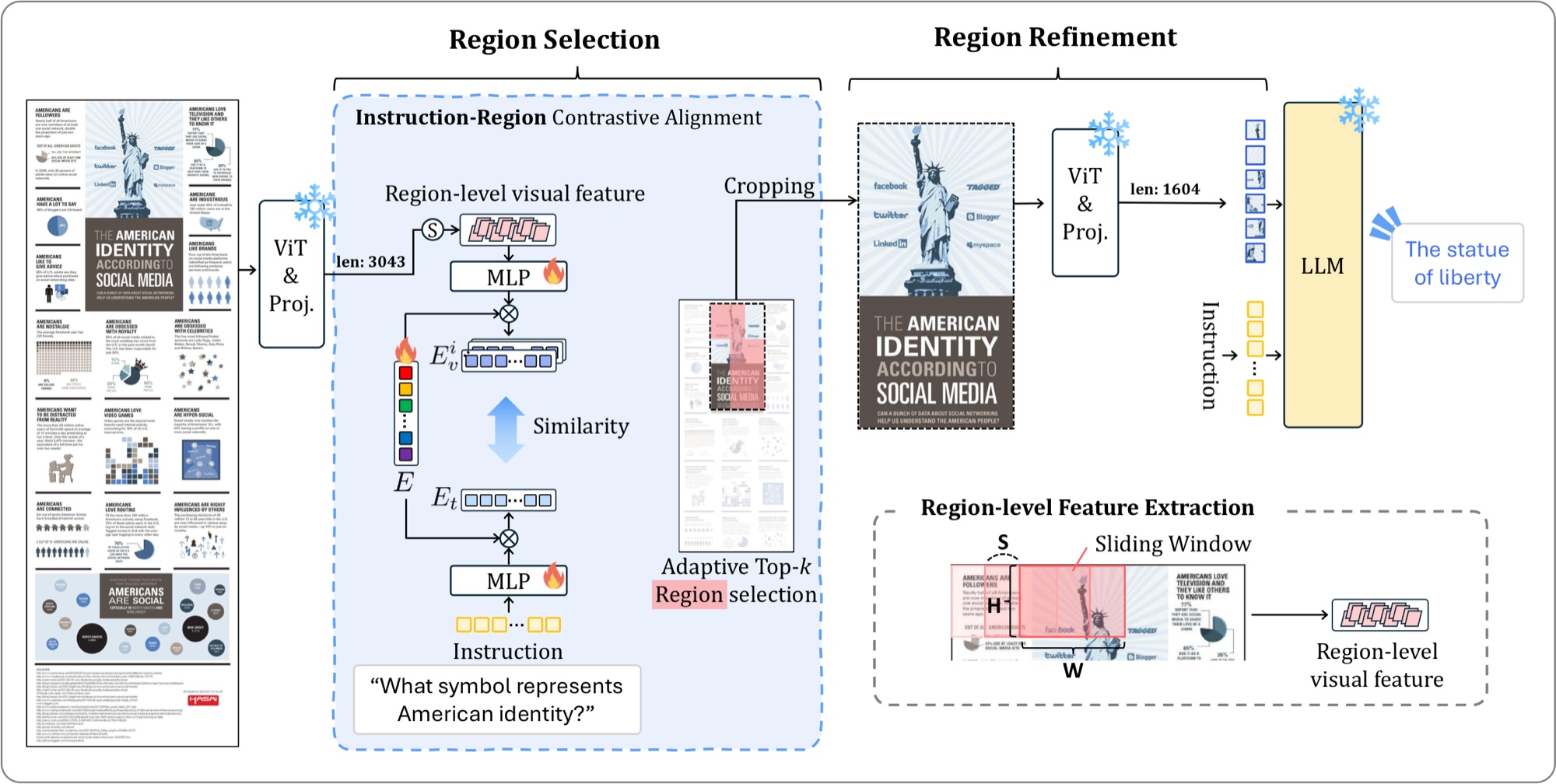
The same thing you do with a Where's Wally page. Stage 1 compares the instruction against region-level features to pick candidate windows. Stage 2 crops those windows and encodes them again in isolation, so the surviving tokens are dense, fine-grained, and free of global contamination.

PinPoint architecture: Region Selection compares instruction and region features, Region Refinement re-encodes the selected crops before the LLM.
Figure 3. Region Selection identifies adaptive top-k instruction-relevant regions via a sliding window over the token map; Region Refinement re-encodes them into fine-grained tokens that go to the LLM.
Stage 1 · Region Selection

Instruction–Region Alignment

Visual tokens are reshaped into a 2D grid and swept with a 10×10 window at stride 7. Learnable guidance queries E attend to each region and to the text, giving both modalities a shared space to be compared in — no CLS token needed, no BPE mismatch. Regions are ranked by cosine similarity to the instruction and taken until they cover a ratio r of the image.

Stage 2 · Region Refinement

Re-encode in isolation

The selected crops are pushed back through the vision encoder on their own. Stripped of global context, the result is a smaller and denser set of tokens that carries genuinely fine-grained detail — which is what reading a 4.9%-of-the-page number in an infographic actually requires.

Training · Contrastive objectives

Two losses, one aligned space

An inter-modal loss aligns instructions with their positive region across the batch. An intra-image loss separates the positive region from the irrelevant regions inside the same image — the distinction that actually matters at selection time. Adding it lifts region accuracy on GQA from 93% to 98%.

Cost · Overhead of the module itself

The scan is cheap

Selection and refinement add 1.67 TFLOPs on LLaVA-NeXT — 7.1% of the total — and 5.68 TFLOPs on Qwen2-VL. Unlike ViCrop, there is no iterative decoding: one lightweight query pass finds the region.

Interactive

Set the coverage ratio, watch the windows land.

Pick a question, then move r — the share of the image PinPoint is allowed to keep. Windows are selected by similarity to the instruction until that budget is spent. Numbers below the canvas are the measured results from the ablation on r (Table A7).

20%40%60%
Region acc.
98%
Coverage
71%
ANLS
.3024
PinPoint answers 42

The canvas is a schematic stand-in for a real infographic — window geometry (10×10, stride 7) and the greedy top-k rule are the ones from the paper. Metrics are read from Table A7 for the selected backbone, dataset and r.

ground-truth region selected window pinpointed answer region tokens 3043 → 1604
Results

Up and to the left.

Accuracy on the vertical axis, compute on the horizontal. Every competing method trades one for the other; PinPoint moves toward the corner where both are better. The dashed line is the vanilla model at 100% FLOPs.

InfoVQA · LLaVA-NeXT-7B

ANLS (↑) vs. FLOPs as % of vanilla (↓)
MethodANLS ↑FLOPs (T) ↓% of vanillaLatency (ms) ↓

GQA is reported as accuracy rather than ANLS. Latency is measured end-to-end, from input processing to generated text.

Qualitative

Where the pruners look, and where we do.

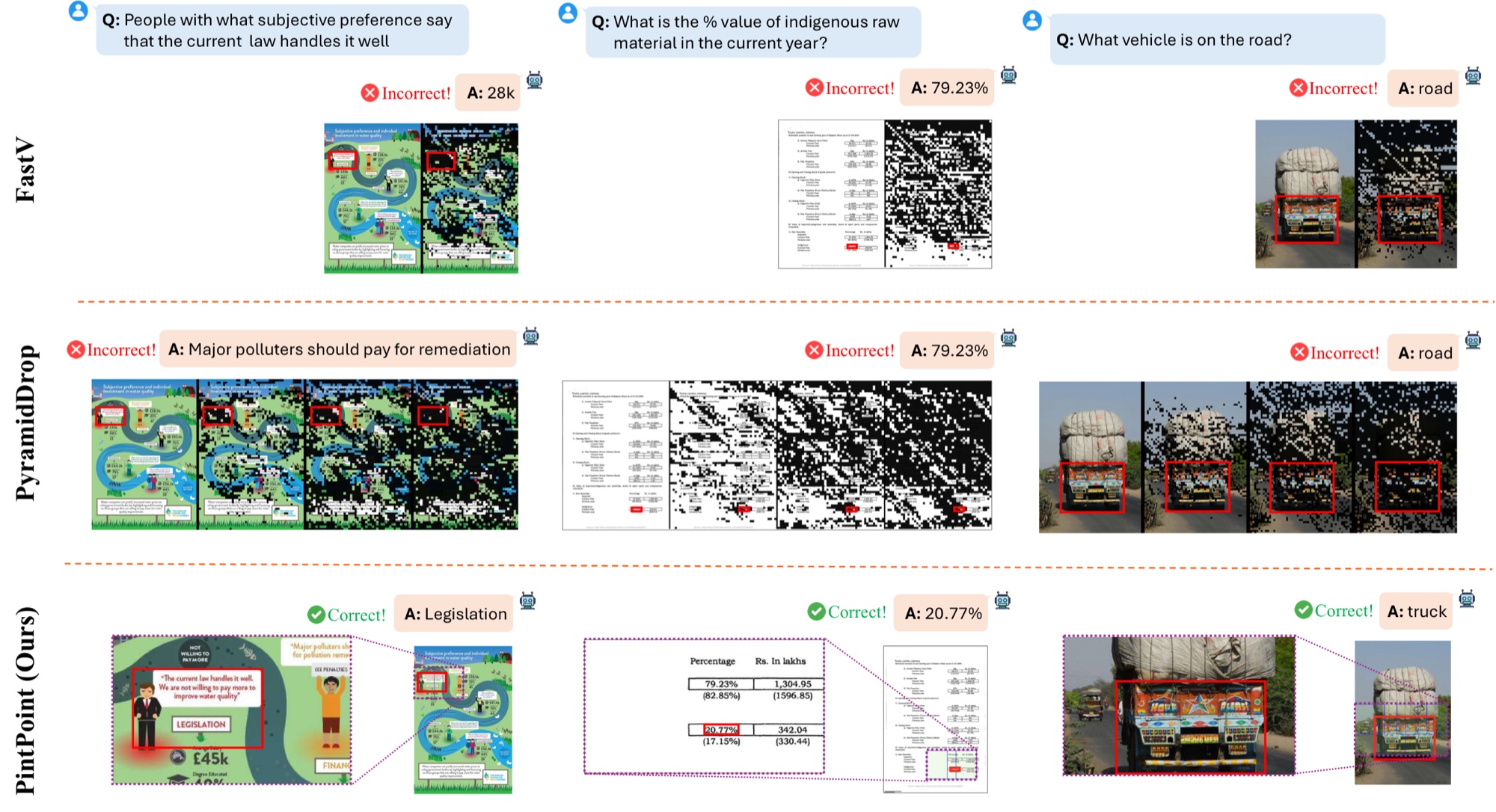
Qualitative comparison: FastV and PyramidDrop prune tokens inside the answer region and answer incorrectly, while PinPoint keeps the region and answers correctly.
Figure 6. FastV and PyramidDrop prune tokens inside the answer region and answer “road” or “79.23%”. PinPoint keeps the region and answers “truck”, “20.77%”. Red = ground truth, blue = selected windows, purple = pinpointed area.
Hallucination · POPE / CHAIR / AMBER

Fewer things that were never there

Grounding the answer in a located region lowers hallucination across both discriminative and generative benchmarks: POPE-adversarial 85.6 → 86.0, CHAIRS 26.1 → 25.6, AMBER Hal 48.9 → 42.4 — at 22.18 TFLOPs against the baseline's 34.32.

Generalization · trained on GQA only

It transfers

Trained exclusively on GQA, PinPoint still beats train-free baselines on MMMU (102.6% of vanilla), MMMU-Pro (106.8%) and TextVQA (136.9%), at 61.1% of vanilla FLOPs. It learns to localize, not to memorize a distribution.

PinPoint dataset

An answer box is not enough supervision.

Answering “what is the object the man is pointing at?” means finding the man first. Prior benchmarks annotate one box around the answer; we annotate the answer, every supporting evidence element, and an encompass box that covers them together — the region that actually grounds the instruction.

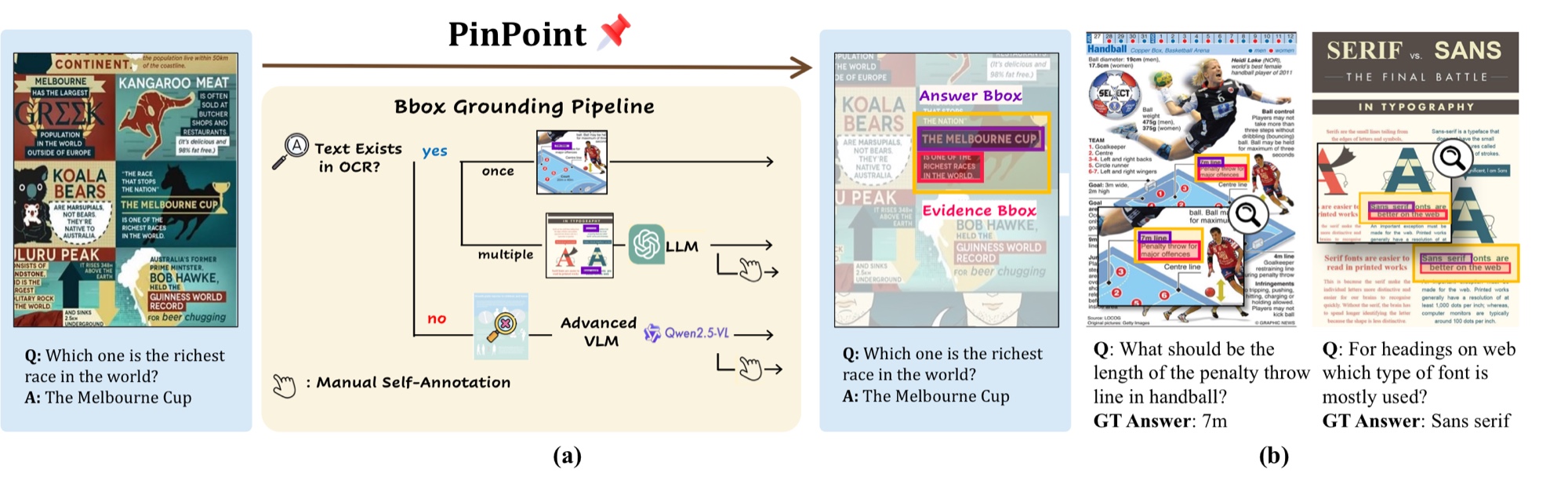
Bounding-box grounding pipeline: OCR resolves unique answer text, an LLM disambiguates multiple candidates, and a VLM handles visual-only answers.
Pipeline. OCR (Textract) resolves the answer text when it appears exactly once; an LLM (GPT-4o) disambiguates when several candidates match; a VLM (Qwen2.5-VL) takes over when the answer is only visually available. For InfoVQA an extra step generates rationale sentences first, then localizes them.
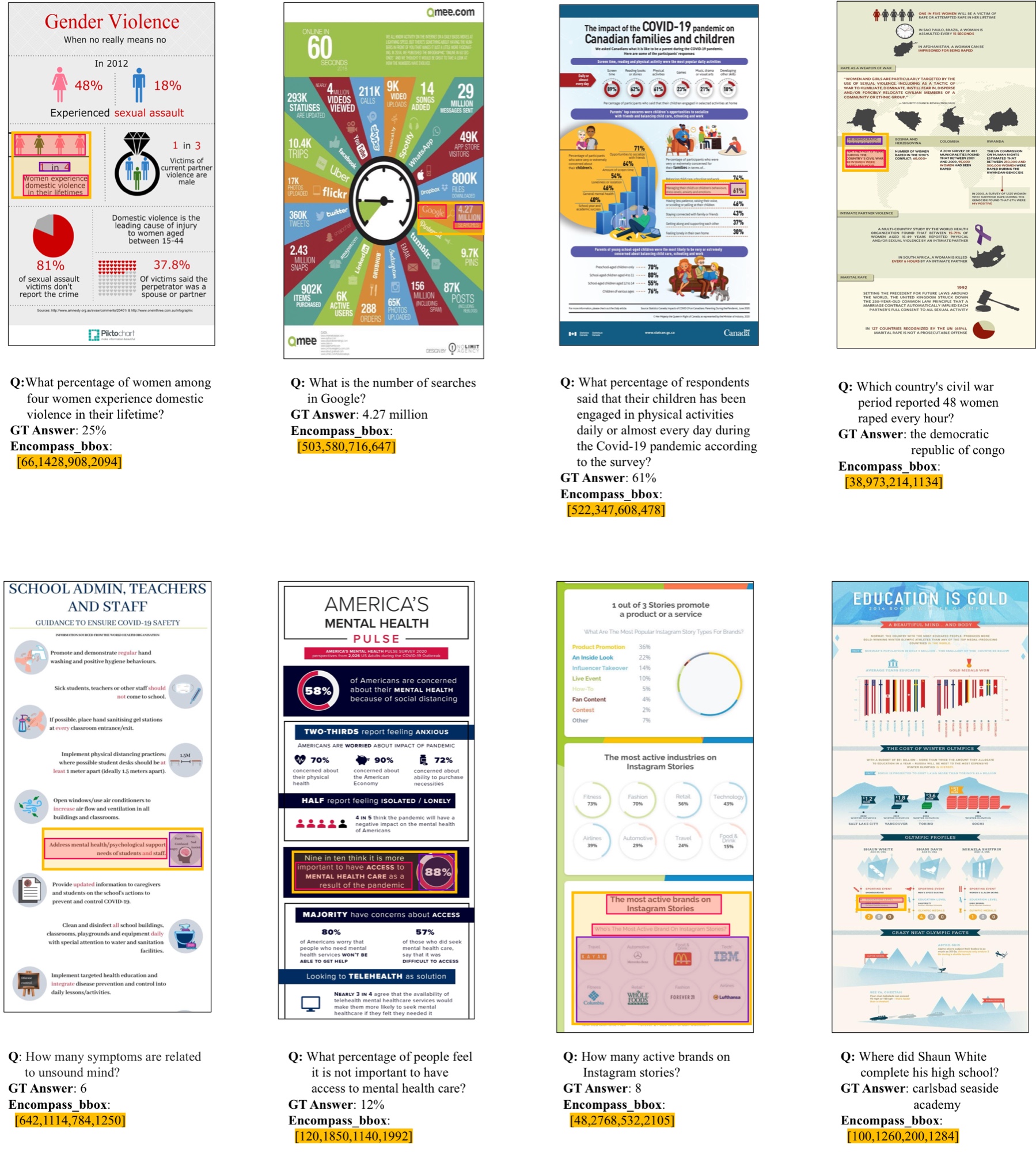
Annotation examples showing the answer box, supporting evidence boxes, and the encompass region that covers them together.
Annotation examples. Purple = answer box, pink = supporting evidence, yellow = encompass region. Training on encompass boxes rather than the tight answer box raises region accuracy on InfoVQA from 82% to 84% and ANLS from .2980 to .3024.
DatasetSplitanswerevidenceencompassImagesPagesQA pairs
InfoVQAtrain1.061.641.04,1621.017,887
InfoVQAval1.091.531.05001.02,801
SPDocVQAtrain1.000.301.010,1941.039,463
SPDocVQAval1.000.281.01,2861.05,349
MPDocVQAtrain1.001.051.05,1319.136,230
MPDocVQAval1.001.021.09275.65,187

Average number of boxes per QA pair. Manual self-annotation stays under 10% on every benchmark. Download and license details will be posted in the repository.

Cite

BibTeX

@inproceedings{kwon2026pinpoint,
  title     = {Focus, Don't Prune: Identifying Instruction-Relevant Regions
               for Information-Rich Image Understanding},
  author    = {Kwon, Mincheol and Lee, Minseung and Choi, Seonga and Choi, Miso
               and Oh, Kyeongjin and Lee, Hyunyoung and Park, Cheonyoung
               and Song, Yongho and Park, Seunghyun and Kim, Jinkyu},
  booktitle = {Proceedings of the IEEE/CVF Conference on Computer Vision
               and Pattern Recognition (CVPR)},
  year      = {2026}
}